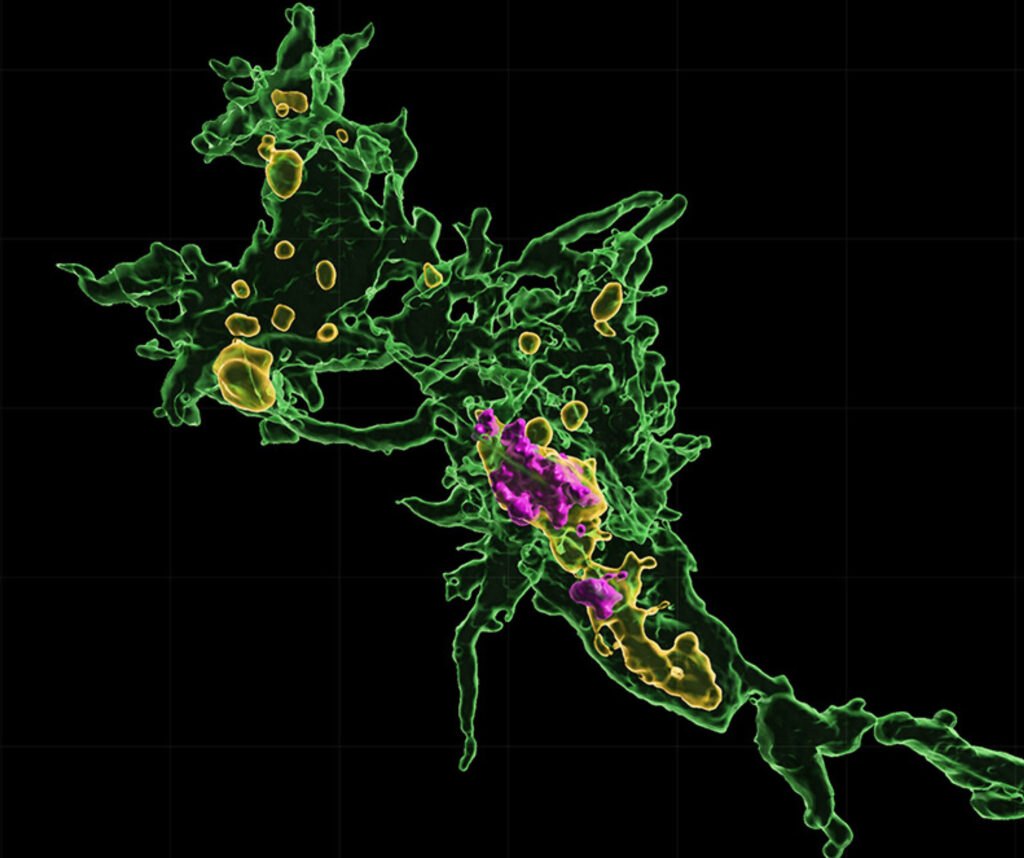
Brain immune cells are eating motor neurons alive in mice with ALS, and a La Jolla research team has identified the protein system that guides them to do it.
Scientists at the Salk Institute, led by distinguished professor emeritus Greg Lemke, discovered that microglia, the brain and spinal cord's resident immune cells, use a family of proteins called TAM receptors to locate and consume living motor neurons in mice with amyotrophic lateral sclerosis. The study was published in Nature Communications on Aug. 15.
It is the first time the TAM system has been shown to target living cells rather than dead or dying ones.
"The bottom line is, microglia are using the TAM system to eat cells that aren't dead," Lemke said in a statement from the Salk Institute on Wednesday, Aug. 19.
Lemke discovered the TAM receptor family more than 30 years ago. Under normal conditions, dying cells display a molecule called phosphatidylserine on their surfaces, essentially waving an "eat me" flag. The TAM system recognizes that signal and dispatches immune cells to clear the debris. The body relies on this process to remove billions of dead cells daily.
Something goes wrong in mice carrying the SOD1 mutation, the most widely used mouse model of ALS, which expresses a protein that causes the disease in humans. Motor neurons begin displaying those "eat me" signals while still alive, and the TAM system sends microglia to devour them.
The researchers found elevated levels of two specific TAM proteins, Axl and Mer, in the spinal cords of SOD1 mice. When they genetically eliminated both proteins, the results were counterintuitive: the mice got sicker faster but lived longer, preserving more motor neurons and muscle control than mice with intact TAM systems.
"When we looked at how many motor neurons mice without Axl and Mer had, compared to mice with Axl and Mer, we found losing the TAM proteins meant preserving muscle controls," said first author Youtong Huang, PhD, a former graduate student researcher in Lemke's lab, in the same statement.
The finding opens potential new immunotherapy targets, though Huang cautioned that simply removing the TAM system is not the answer. Effective therapies would need to address the underlying mechanisms of ALS alongside the TAM pathway, she said.
ALS affects roughly 35,000 Americans, with 5,000 new diagnoses each year, according to the CDC. Existing treatments only slow progression.
The implications may extend beyond ALS. Elevated Axl is already a hallmark of Alzheimer's disease, and Lemke's earlier work showed microglia require TAM receptors to respond to amyloid plaques. Research groups in Japan and Korea have already engineered TAM-based proteins to target live cancer cells and autoimmune B cells in mice, building on the Salk findings.
Lemke, a member of the National Academy of Sciences, said the TAM system could offer a simpler path to immunotherapy than engineering entire cells. No clinical trials in humans have been announced. The work was funded by the National Institutes of Health, Harvard Medical School, UC San Diego and the H.A. and Mary K. Chapman Charitable Trust.