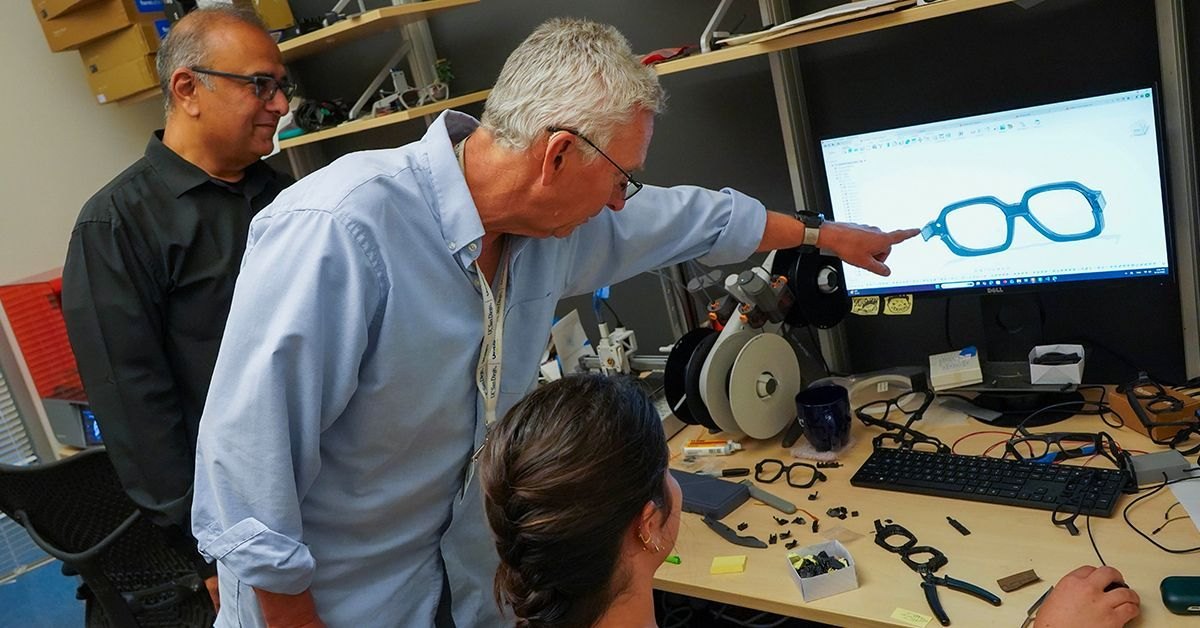
Aynak Inc., a La Jolla startup incubated at UC San Diego's Qualcomm Institute, is looking for San Diego County volunteers to try prototype eyeglasses that double as hearing aids.
The company plans to distribute about 35 pairs of AI-powered hearing glasses through local optical stores this fall, with a second round in January 2027, according to UC San Diego. Interested residents can sign up on Aynak's pilot page.
Founder and CEO Ramesh Chandrasekhar, who spent 26 years at Qualcomm working on augmented reality and miniaturized electronics, said the pilot will put the glasses in real-world settings. "People will wear the glasses in typical environments where things are noisy, especially during the holidays," Chandrasekhar said. "We'll get feedback on how they are doing."
The idea grew from a personal frustration. Chandrasekhar said his mother-in-law began losing her hearing around 2015 and resisted traditional hearing aids because of stigma. The family eventually spent about $15,000 on roughly seven pairs, he said, yet she still struggled in noisy restaurants and group conversations and began withdrawing socially.
Chandrasekhar's solution uses what Aynak calls a "multimodal" approach. A small vision sensor and directional microphones are built into the eyeglass frames. On-device AI combines those inputs in real time to amplify the voice the wearer is focused on while preserving surrounding sounds.
Because the processing happens on the glasses rather than in the cloud, the system can keep up with the milliseconds-thin margin between amplified and natural sound reaching the ear. A companion smartphone app lets users adjust frequencies to their own hearing profile.
The latest prototypes come in two frame styles and are fitted with the wearer's prescription lenses. Participants need a current eyeglass prescription, an iPhone or Android phone and the ability to attend two local appointments.
The company notes on its pilot page that this is an early prototype and some features may not work as expected.
Aynak operates out of the QI Innovation Space on the UC San Diego campus with six employees, including COO Dan Luka and mechanical engineer Iva Orlic. Two staffers are UC San Diego alumni. The company also has two remote U.S. employees and a small team in India.
Erik Viirre, director of the Arthur C. Clarke Center for Human Imagination and adjunct professor of neurosciences at UC San Diego School of Medicine, serves as an adviser. He encouraged Chandrasekhar to apply to the QI Innovation Space, which provides workspace and access to university resources without taking an equity stake in its startups.
About 15% of U.S. adults report some trouble hearing, according to the National Institute on Deafness and Other Communication Disorders. Among adults 20 to 69 who could benefit from hearing aids, only about 16% have ever used them, the NIDCD reports. The rate rises to 30% for adults 70 and older.
Chandrasekhar said Aynak's long-term business model is to license the technology to eyewear manufacturers rather than sell glasses directly. The company is also exploring lower-cost frames for countries where audiology services are scarce and working with research partners in Japan on new sound-delivery methods.
The specific optical stores handling distribution have not yet been announced.