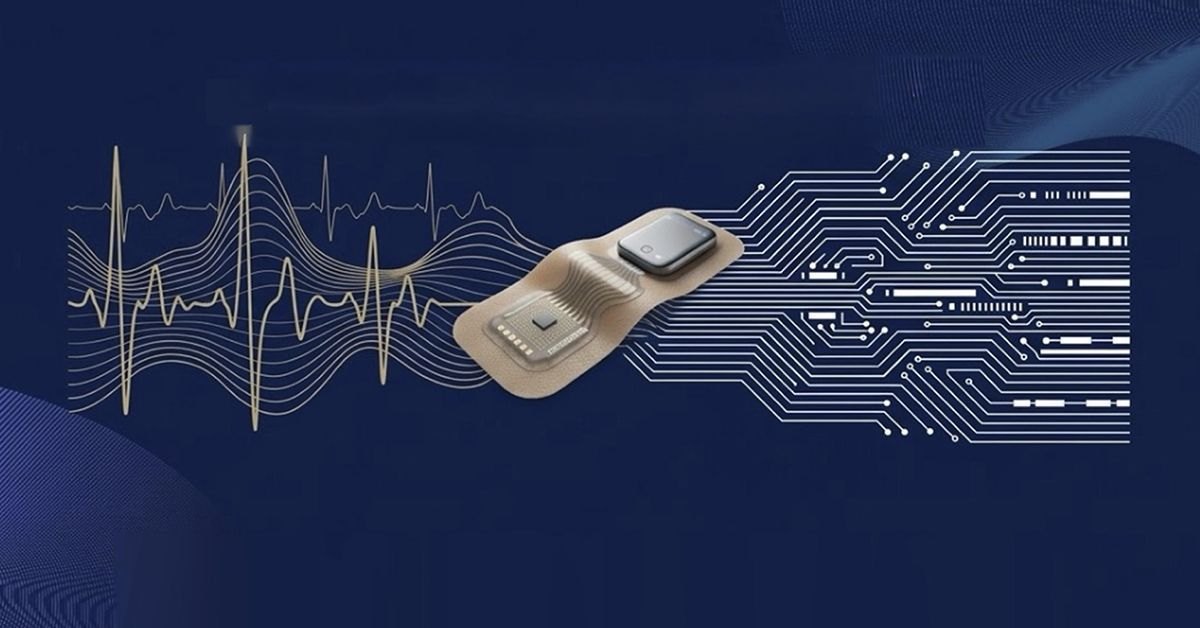
A La Jolla biotech startup will use up to $3.9 million in federal funding to run the company's largest trial yet of a wearable patch that monitors sepsis patients' immune responses in real time.
InflammaSense, incubated at UC San Diego's Qualcomm Institute, won the subaward as part of a $38 million contract from the Advanced Research Projects Agency for Health (ARPA-H) to the University of Vermont. UC San Diego announced the award Wednesday, Oct. 7. The trial will track more than 200 sepsis patients using the company's VITALx-patch, a noninvasive device the company describes as smaller than a business card.
The patch reads immune activity from magnetic and electrical signals in nerves in the neck. It then feeds that data into an algorithm that sorts patients by immune trajectory. The device was built in the Qualcomm Institute's specialized facilities, including its magnetically shielded magnetoencephalography room and Nano3 cleanroom.
"Why are we treating everybody with the same Phillips screwdriver when they may need a flathead?" said Imanuel Lerman, CEO and co-founder of InflammaSense and a clinical professor of anesthesiology at UC San Diego School of Medicine. "It's the wrong tool for the wrong patient, and it has to be given at the right time."
Lerman co-founded the company after studying the vagus nerve, which helps regulate inflammation. His research found that patients receiving the same treatment can respond very differently.
Beginning in 2019, support from the Biomedical Advanced Research and Development Authority (BARDA) enabled Lerman and colleagues to test whether nerve activity recorded from the neck could reveal the body's response to inflammation. A controlled study of healthy volunteers confirmed the link, with results published in Communications Biology in 2024.
About $4.5 million in prior federal support from BARDA, the Defense Advanced Research Projects Agency and the National Institutes of Health, plus a $1.4 million seed investment, brought the technology to its current stage, according to Lerman.
The larger project, called ReSCUED (Reprogramming Severe Critical Illness Using Extensible Digital Twins), is part of ARPA-H's CIRCLE program (Critical Illness Immunological Reprogramming and Control Point Learning Engine). Gary An, a University of Vermont trauma surgeon, leads the effort as principal investigator. The UVM-led initiative aims to create digital twins of critically ill patients, modeling their immune state and simulating how they might respond to different FDA-approved medications.
About 1.7 million adults in the U.S. develop sepsis each year, and at least 350,000 die during hospitalization or are discharged to hospice, according to the Centers for Disease Control and Prevention.
ReSCUED is structured as a milestone-based initiative of up to five years. During the first three years, researchers will develop and validate the digital-twin technology before progressing to clinical trials with critically ill patients. Clinical sites include Wake Forest University School of Medicine, the University of Alabama at Birmingham and Washington University School of Medicine.
No trial start date has been announced. InflammaSense remains a pre-revenue company headquartered in the Qualcomm Institute Innovation Space on the UC San Diego campus.