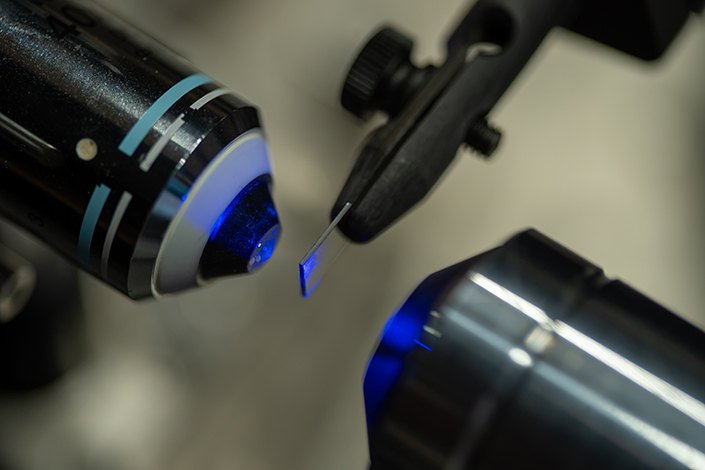
UC San Diego engineers switched magnetic data-storage states using a shaped laser beam, a method they estimate is more than 1,000 times faster than current technology.
The findings, published in the journal Nature Communications on Thursday, Sept. 24, come from the Jacobs School of Engineering at the university's La Jolla campus. The team described a technique that could point toward smaller, faster and more energy-efficient hard drives and memory devices, according to a UC San Diego announcement.
In current storage technology, tiny magnetic regions represent the 1s and 0s of digital information. Flipping those states requires an external magnetic field, which consumes significant energy and limits writing speed. The La Jolla researchers replaced that magnet with an ultrafast laser beam they shaped and shrank to an extremely small scale.
The study's senior author, Abdoulaye Ndao, an assistant professor of electrical and computer engineering, said the approach broke through a barrier that had stalled the field. Previous research showed optical switching worked only in very thin magnetic stacks of three layers or fewer, and only with a specific type of polarized light.
Adding more layers killed the effect.
Ndao's team demonstrated switching in a nine-layer material made of alternating platinum and cobalt. They also found the technique no longer depended on the light's polarization.
"Instead of designing a new material to enable optical switching, we redesigned the light itself and showed new properties that were not previously thought to be possible," Ndao said in the university's announcement.
The mechanism concentrates laser energy onto a tiny area using multiple ultrafast pulses. The first pulses heat a small region enough to create a reversed magnetic zone. Subsequent pulses expand that zone until it stabilizes.
Muhammad Waleed Khalid, a Ph.D. student in Ndao's research group and the study's first author, said the results were so unusual that the team spent extensive time repeating and verifying experiments to substantiate their work to the optics community.
The project paired Ndao's optics lab with Eric Fullerton, a professor of electrical and computer engineering and chemical and nano engineering who holds the Endowed Chair at UC San Diego's Center for Memory and Recording Research (CMRR). The collaboration bridged optics and magnetic-materials research, two fields that rarely overlap, according to the university. Ndao was appointed a CMRR faculty fellow in August 2026.
Commercial application is not imminent. The specialized ultrafast laser used in the experiments cannot yet be integrated into computer chips. The team is working to shrink the beam further, potentially to a few hundred nanometers, and is exploring optical structures that could confine light into even smaller spaces.