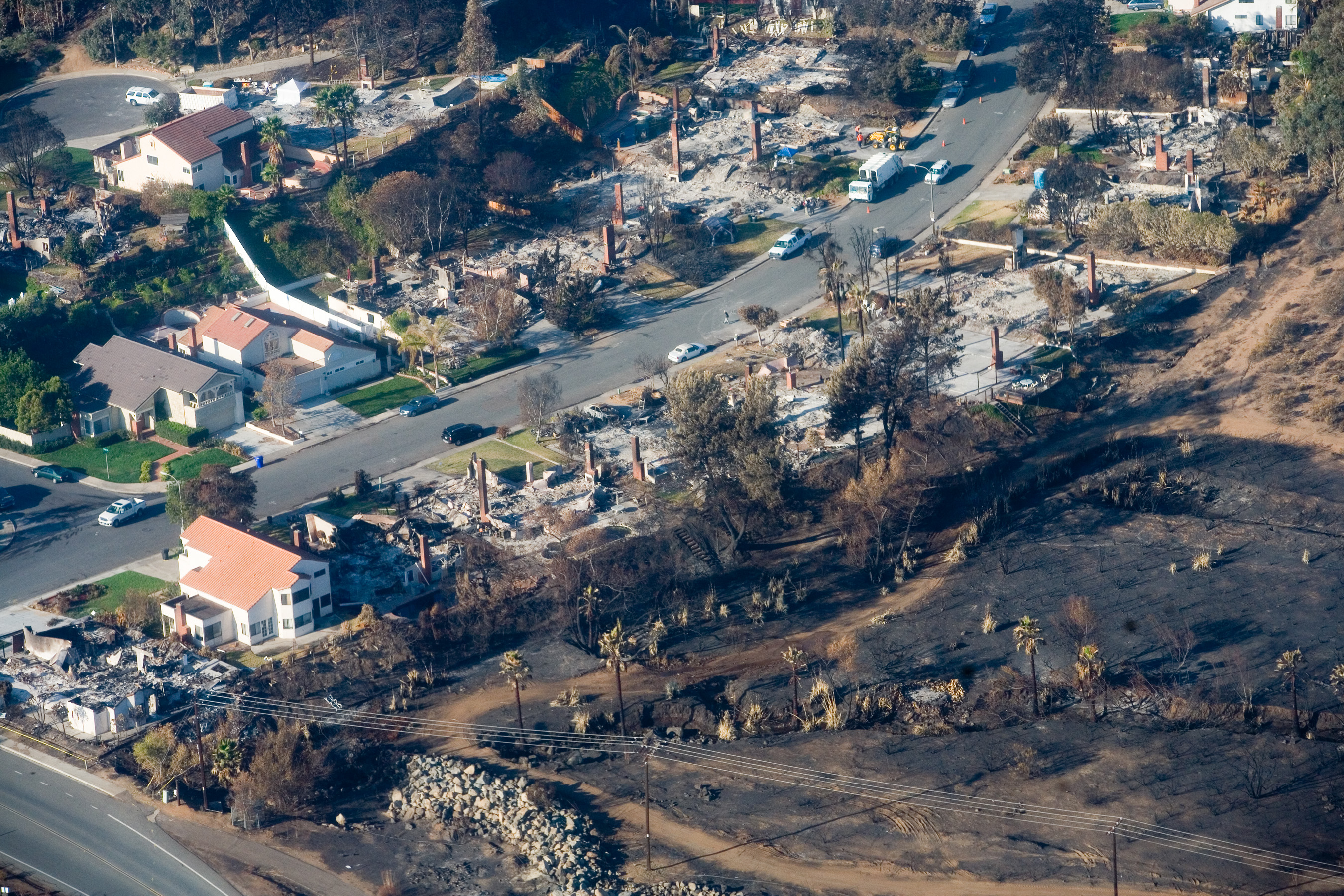
Wildfire victims lose an average of $35,000 in earnings over three years after losing their homes, according to a new study co-authored by a La Jolla economist.
The National Bureau of Economic Research (NBER) published the working paper Monday, Aug. 31. Judson Boomhower, an associate professor of economics at UC San Diego's School of Social Sciences, co-authored the study with researchers from the University of British Columbia, the University of Virginia and the U.S. Census Bureau.
The team analyzed address-level damage data from about 100,000 people and 50,000 homes across more than 100 wildfire zones. They found that households losing their homes see earnings drop for three years, peaking at about 10% in the first year. Over that stretch, the average victim loses the equivalent of 26% of pre-fire annual income.
Lower-income households within fire zones are more likely to lose their homes, Phys.org reported, even though wildfire victims overall tend to be wealthier than victims of some other natural disasters.
Half of burned homes sit empty four years after a fire.
The homes that are reoccupied tend to draw residents with systematically higher incomes and systematically lower ages than those who lived there before. The authors call the pattern "post-disaster gentrification."
"Earnings fall for years after the fire and people do not simply bounce back even after rebuilding," Boomhower said in a statement accompanying the paper's release.
The study linked property damage records with income tax and Census data but did not directly measure whether homeowners had adequate insurance coverage. The analysis focused on occupants of single-family homes.
Boomhower said the findings frame wildfire as a market and policy challenge, not only a climate and public safety concern. His co-authors are Patrick Baylis of the University of British Columbia, Jonathan Colmer of the University of Virginia and John Voorheis of the U.S. Census Bureau.
NBC San Diego reported that the paper's conclusions point to economic pressure on policymakers, insurers and households as wildfire zones expand. The study's data covered more than 100 fires across the country, drawing on records that tracked individual households before and after each blaze.