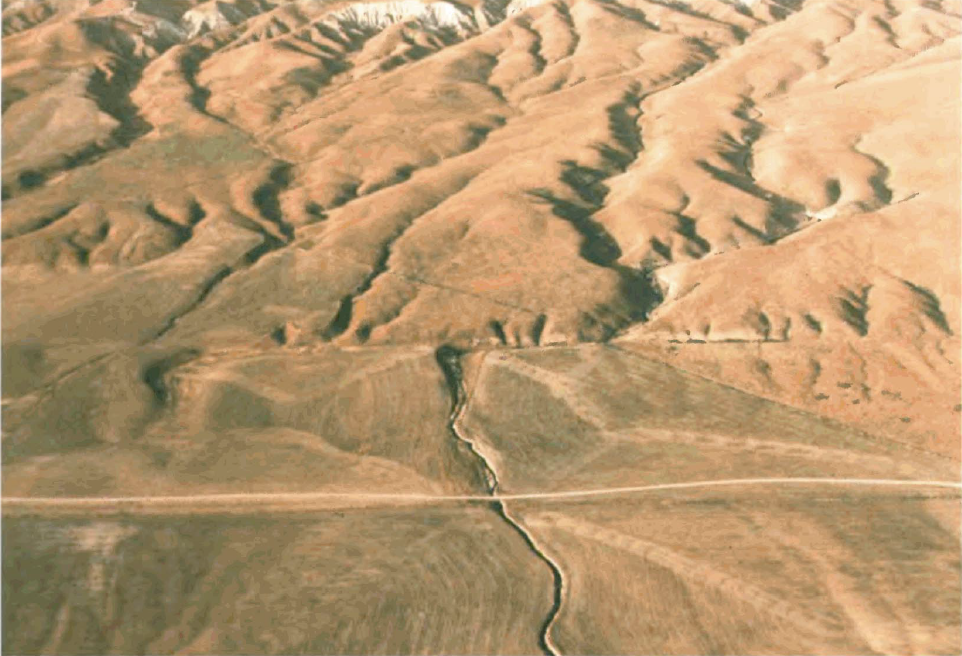
La Jolla geophysicists say Southern California's next major earthquake on the San Andreas Fault could be larger than any before it.
The warning comes from a new study at Scripps Institution of Oceanography at UC San Diego, published Wednesday, Oct. 14, in the journal Nature Communications. Researchers identified a phenomenon they call "minimal slip predictability," which compares how much a fault moves during a major quake, how fast it slips between quakes and how long since the last big rupture.
More wait means more strain. The southern San Andreas Fault has not released its accumulated strain in more than 300 years, according to Scripps.
"If the inferred pattern holds, the next one could be larger than its predecessors, and the same analysis tells us which side of the fault will shake harder," said Yuri Fialko, a geophysicist at Scripps Oceanography and senior author of the study.
Fialko said the strongest shaking during a "Big One" would likely hit the fault's northeast side, toward Southern California's High Desert. That is preferable to the alternative direction toward the densely populated Los Angeles metropolitan area, according to the study. But researchers said the effects of a large earthquake would be major on all sides of the fault.
Myanmar quake as proving ground
The international team used a devastating magnitude 7.8 earthquake that struck Myanmar on March 28, 2025, as its case study. That quake ruptured roughly 300 miles of the Sagaing Fault, killed 3,600 people and damaged buildings as far as Bangkok, about 620 miles away.
Satellite measurements taken before the quake showed where the fault was locked and accumulating strain. Models built from that pre-earthquake data predicted the path of the quake's energy. The displacement observed during the earthquake was consistent with the strain the fault had stored since it last ruptured in 1839, a seismic gap of 186 years.
A chance closed-circuit television recording offered an unexpected clue. A camera 75 miles south of the epicenter filmed sections of landscape on either side of the fault sliding past each other. It was the first time a fault rupture had been caught on video, according to the study.
"This earthquake shows that some important aspects of a large earthquake can also be constrained beforehand: the fault's shape at depth, a lower bound on how much it will slip, and the conditions for a very fast rupture," said Alice-Agnes Gabriel, a geophysicist at Scripps and corresponding author of the study.
The researchers note that the Sagaing Fault is shaped very similarly to the San Andreas Fault. The study builds on a predecessor that examined Turkey's deadly 2023 earthquakes, which struck a fault system Fialko has called structurally similar to the San Andreas.
ShakeOut drill set for Oct. 15
The study's release comes one day before ShakeOut, one of the largest earthquake preparedness drills conducted each year. On Thursday, Oct. 15, an estimated 10 million Californians and 70 million people worldwide are expected to participate in earthquake safety drills at work, school and home.