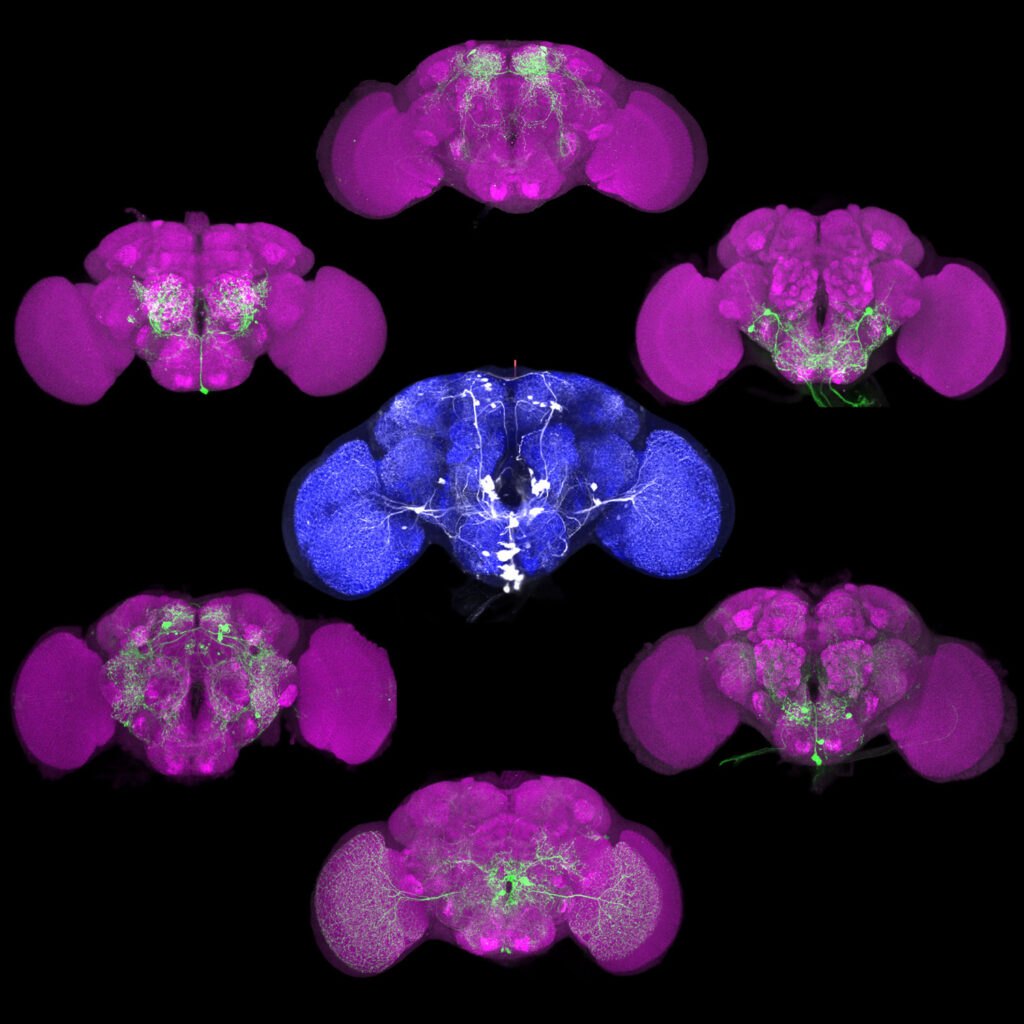
Salk Institute scientists in La Jolla have built a genetic toolkit that can target individual neuron types inside a fruit fly brain, pinpointing one group that suppresses aggression and another that guides flight.
The study, published Thursday, Aug. 27, in Current Biology, addresses a long-standing puzzle: how a single brain chemical can trigger opposite behaviors depending on which neuron releases it. The chemical in question, octopamine, is the fruit fly equivalent of noradrenaline in humans and influences aggression, feeding, wakefulness and memory.
"Almost every brain cell is different … We can't really study precisely how the brain works if we are handling a group of neurons as a single unit," senior author Kenta Asahina, associate professor at the Salk Institute, said in a news release. "Now, we can begin asking what each specific neuron is actually doing."
The team screened several hundred genetically engineered fruit fly lines to find overlapping expression patterns. The resulting toolkit uses split-GAL4 driver combinations to narrow access to specific neuron groups. In some cases it targets just a single pair of neurons, according to Genetic Engineering and Biotechnology News.
With that precision, the researchers identified a previously undescribed neuronal subgroup called ASM4 that suppresses aggression in flies housed in groups. ASM4 performed that role in both males and females, even though aggression typically differs between the sexes.
The team also found that ASM4 neurons appear unable to convert the chemical tyramine into octopamine. Because the two chemicals can have opposing effects, the researchers hypothesize that ASM4's function depends on both the neuron type and the specific signal it releases.
A separate group of neurons identified by the toolkit plays an entirely different role: helping flies track visual motion during flight. Co-first author Valentina Fajner, staff scientist at Salk, said the contrast illustrates the study's central point: one chemical modulator, but distinct neurons performing distinct jobs.
The study was co-led by Fajner and Lesly Palacio Castillo of UCLA. Additional authors include researchers from Salk, UC San Diego and UCLA. The National Institutes of Health funded the work through two grants.
Next, the team plans to map input and output signals in the octopamine system to understand how social stimuli promote or suppress aggression in fruit flies.