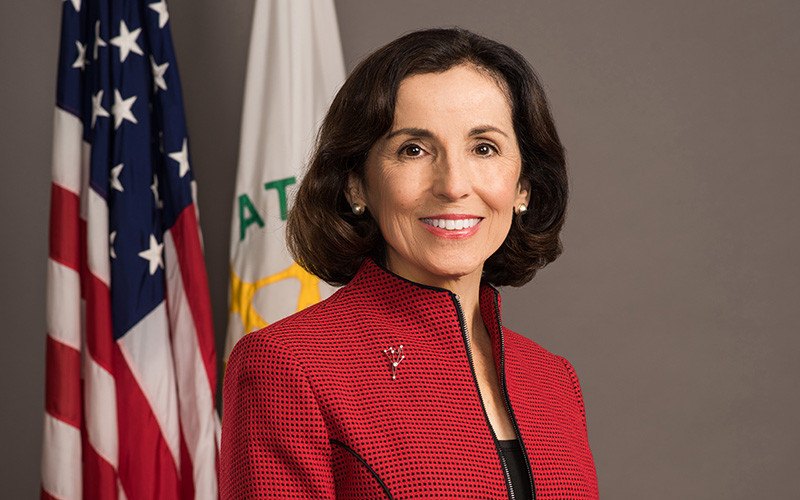
Astrophysicist France Córdova will deliver a free public lecture on how satellite constellations are dimming humanity's view of the night sky when she accepts the 2026 Nierenberg Prize for Science in the Public Interest on Thursday, Oct. 22, at 6 p.m. at the Robert Paine Scripps Forum on the Scripps Institution of Oceanography campus in La Jolla.
Scripps, part of UC San Diego, announced Aug. 24 that Córdova is this year's honoree. The prize carries a bronze medal and $25,000.
Seating is limited and advance registration through Eventbrite is required.
Who is France Córdova?
Córdova served as NASA's chief scientist in 1993, becoming the youngest person and first woman in that role, and received the agency's Distinguished Service Medal. Former President Barack Obama nominated her to lead the National Science Foundation in 2013; the Senate confirmed her in 2014, and she served as the NSF's 14th director through March 2020.
She was also the first woman to serve as president of Purdue University, beginning in 2007, and is chancellor emerita of UC Riverside, where she laid the groundwork for California's first new public medical school in more than 40 years. She has served in five presidential administrations, both Democratic and Republican, according to the Science Philanthropy Alliance, where she is president.
Córdova holds a bachelor's degree from Stanford University and a PhD from the California Institute of Technology, and has published more than 150 research papers on X-ray and gamma ray sources and space-borne instrumentation.
What she'll talk about
Her presentation, titled "Vanishing Darkness: Preserving Our Window to the Universe," will explore how satellite constellations threaten astronomical observation and how technological innovation can coexist with stewardship of the space environment.
"Preserving an unobstructed window on the universe is not about resisting progress; it is about ensuring that humanity's expanding presence in space enhances, rather than diminishes, our capacity for discovery," Córdova said in the Scripps announcement.
About the prize
The Nierenberg Prize is awarded annually by Scripps Institution of Oceanography, created through a gift from the Nierenberg family to honor William A. Nierenberg, who served as Scripps director from 1965 to 1986. Past recipients include primatologist Jane Goodall, filmmaker David Attenborough, former NASA administrator Charles Bolden and Nobel Prize winners Jennifer Doudna, Katalin Karikó and Svante Pääbo.
The Nierenberg family said in the announcement that Córdova's influence on bipartisan U.S. science policy makes her a fitting recipient of a prize dedicated to science in the public interest.